
Arlington Parole and Probation Compared
Parole and probation are forms of community supervision, but they begin in different ways. Virginia generally ended ordinary discretionary parole for felony offenses committed on or after January 1, 1995, though the law preserves detailed exceptions. That rule is one reason not to label every person released from Arlington County custody a parolee. A court may order probation instead, either in place of active jail time or after part of a sentence has been served. A person may also finish all custody with no remaining supervision.
The latest sentencing or release order supplies the legal basis. VADOC administers state probation and parole supervision, while the Virginia Parole Board makes parole decisions for eligible cases. The comparison helps identify which record owner to check.
| Record type | How it begins | Best Arlington verification |
|---|---|---|
| Parole | Conditional release from a parole-eligible sentence after a Board decision and release processing | VADOC locator, signed parole conditions, and Parole Board decision report |
| Probation | A court orders community supervision, with or without a term in custody | Latest Arlington court order plus the VADOC supervision record |
| Post-release supervision | A supervision term follows physical release under the sentence and release documents | Release order, conditions, VADOC record, and District 10 confirmation of the public channel |
| Discharge | The legal term of custody or supervision ends | Discharge order, release letter, court record, or VADOC records response |
A few terms carry precise meanings. They should not be swapped merely because someone lives in the community.
- Parole
- Conditional community release for a person who is eligible under Virginia law and approved through the parole process.
- Probation
- Court-ordered supervision that can be imposed instead of incarceration or after active time.
- Absconder
- A supervisee alleged to have stopped reporting or otherwise left supervision without authorization.
- Discharge
- The formal end of a custody or supervision obligation, not just departure from a facility.
Verify Arlington Post-Release Supervision
The VADOC Inmate and Supervisee Locator covers people in state custody and people currently supervised by VADOC district offices. It is updated daily, but VADOC warns that information may be inaccurate or out of date. Search with first and last name or a seven-digit DOC ID. Location, race, gender, and age range can narrow a result. A county booking number is not automatically a DOC ID.
A locator result must be matched by identity and read within its scope. A community-supervision match can show that the person is outside prison but still under VADOC authority. It may not by itself explain whether that authority is parole, probation, or post-release supervision. Fully discharged people are not promised as permanent locator entries, so a miss does not prove that supervision ended.
- Search the VADOC locator by name or DOC ID and compare the identifiers carefully.
- Read the current location and supervision information. Do not convert a locator miss into a discharge finding.
- Use the Arlington court docket and latest order to identify probation, a suspended term, or another court-imposed condition.
- Find Arlington District 10 in the VADOC office directory and ask which public record channel can confirm the supervision district.
- Request the signed release conditions or discharge record when formal proof is needed.
The Arlington County released-person search and release-record routes are explained on the Arlington County released inmates home page. That route is useful when the open question is departure from ACDF rather than active supervision.
Note: A court order explains the legal term, while the VADOC locator reports the agency's current supervision scope.
Arlington District 10 Supervision Office
Arlington has a named local supervision office. The VADOC Facilities and Offices directory lists Arlington District 10 and says it serves Arlington County and Falls Church. A verified locator match and the office directory can identify the district responsible for an active VADOC supervision record. The office can direct a caller to the proper public process, but it should not be expected to disclose confidential case details.
VADOC Arlington District 10
3300 North Fairfax Drive, Suite 320
Arlington, VA 22201
703-875-0100
Service area: Arlington County and the City of Falls Church
Bring the right identifiers to any inquiry. A full name, date of birth when lawfully available, DOC ID, court, and case number can prevent a wrong-person match. The district office is not the source for the exact minute someone left Arlington County Detention Facility. ACSO owns that local release transaction, and the court owns its order.
Arlington Parole Warrants and Absconders
A supervision violation does not have one public Arlington list. VADOC explains that officer arrest warrants, court capiases, and Parole Board warrants may be filed with law enforcement. A capias is a court order directing that a person be taken into custody. The source depends on who issued the process, so the locator, court docket, District 10, and proper law-enforcement channel may all matter.
The VADOC Most Wanted page is selective. It is not a full list of every Arlington absconder or active warrant. Some public cards later show a captured status, but a person's absence from the page proves nothing about warrant status. VADOC directs tips to 1-877-896-5764 or local law enforcement, and no one should try to apprehend a listed person.
The official Most Wanted page shows why this source must be treated as a limited statewide channel.
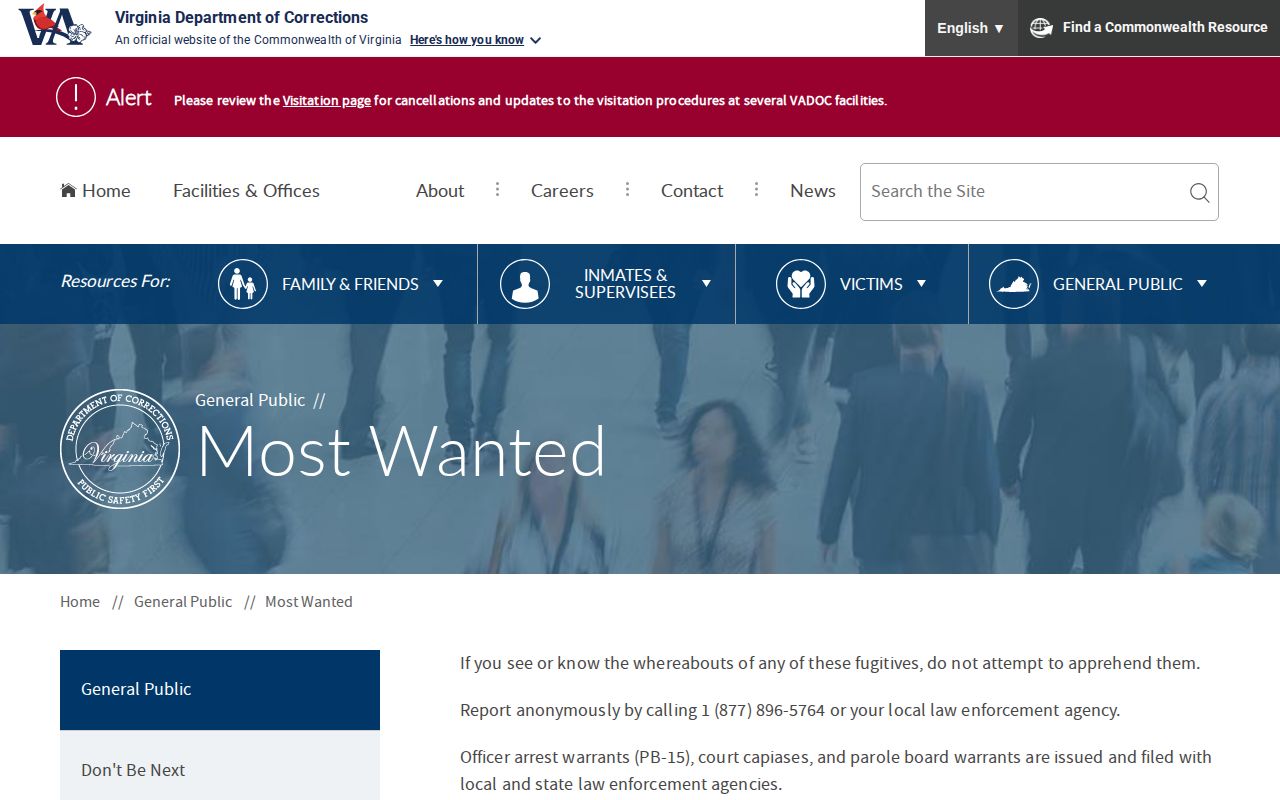
The captured and wanted cards supplement agency records; they do not replace an Arlington court or supervision inquiry.
Note: Never treat absence from a selective wanted page as proof that no violation warrant exists.
Arlington Reentry After Release
Arlington's transition network includes two programs within the office led by Sheriff Jose Quiroz Jr. on the research date. The Arlington Reentry Committee describes intake assessment, pre-release meetings, referrals, discharge-plan review, and follow-up. The Community Readiness Unit describes risk assessment, one-on-one planning, workshops, therapy, post-release case management, support groups, and family support.
These services can help a person move from custody into the community and comply with a release plan. They are not parole or probation databases. Participation also does not prove that a person was released on a given date. Use the signed release record and supervision documents for that question, then use the programs for their stated support role.
Arlington Parole Hearing Records
The Virginia Parole Board publishes public meeting information and monthly decision reports. The calendar is event-based and irregular, not a fixed weekly schedule. An entry can include the date, time, agenda or meeting link, people to be heard when announced, and minutes. Not every eligible person must appear on one upcoming agenda, so the absence of a name is not a custody conclusion.
Decision reports are monthly PDF files rather than a name-search database. Open the relevant month and search within that report. A grant is a decision in the parole process. It is not proof that physical release has occurred, because conditions and release planning can follow. Actual departure and supervision should be confirmed through VADOC, the release documents, and an applicable state notification.
Eligibility is case-specific. Virginia Code § 53.1-165.1 generally limits parole for post-1994 felony offenses but contains exceptions. Section 53.1-151 addresses eligibility calculations for eligible sentences. The live statutes and the person's sentence record control. A broad summary cannot decide an individual case.
Arlington Supervision Notification Limits
Virginia uses separate notification systems for local jail and state custody. Virginia Jail VINE can report a local release or transfer event for a selected jail record. It does not determine whether later supervision is parole or probation. A transfer event can mean movement into VADOC authority rather than return to the community, so the receiving system and the court order must still be checked.
For eligible state notifications, VADOC now uses NAAVI and Victim Services. State notices can concern anticipated release, actual release, transfers, work release, parole events, escape or recapture, death, and a name change. Local Jail VINE registration does not automatically become a state NAAVI registration. Actual release ends VADOC physical custody, but it does not always end probation, parole, or post-release supervision.
Notifications supplement the supervision record. They do not replace the VADOC locator, signed conditions, court order, or District 10 channel. Keep the reported agency and event type attached to any notice, especially when the date differs from another record.
Note: Local Jail VINE and state NAAVI report different custody scopes and require separate registration where eligibility rules permit.
Ending Arlington Post-Release Supervision
Supervision ends through a formal discharge, expiration, or court action under the governing record. Stopping reports, leaving the locator, or completing a program is not enough by itself. The best proof is the discharge order or letter, paired with the court and VADOC record. When sources conflict, compare their event dates and agency scope before drawing a conclusion.
Conditions are set by the applicable order and can include reporting and other case-specific duties. A claimed violation may lead to an officer warrant, capias, Board process, or court hearing. The latest order shows what the court decided, while District 10 holds the supervision record. If the locator, court docket, and office information do not align, ask each record owner about its own entry and present the conflict as unresolved.
A VADOC physical release can be documented by a notification-of-release letter and signed conditions of probation or parole. Those records distinguish leaving a facility from completing the whole legal term. They also keep Arlington parole and probation verification tied to the actual record instead of an assumption based on a missing online result.