
Arlington County Release Date Basics
A projected date is a current computation, not a promise. It estimates when a sentenced person may leave the authority that now holds the sentence. An actual release date is the recorded day custody ended for that agency. The two can differ because a court changes the sentence, credit is earned or lost, another hold applies, or the person moves to another custodian.
Pretrial custody works another way. A person awaiting trial at the Arlington County Detention Facility does not yet have a final active sentence from which staff can compute a discharge date. A magistrate or judge may authorize recognizance, bond, or supervised pretrial release. Conditions still must be met and the Sheriff must process the order. The court order explains the authority, while the ACSO release transaction supplies the local departure time.
Choose Arlington's Correct Release Path
The first task is to identify custody type. Arlington has one adult county jail, but no VADOC prison within the county. A person can still be state-responsible while held at ACDF, or can leave the jail for a state institution. The calculating authority depends on the sentence and active time, not just the building where the person sleeps.
| Situation | Best date source | What it can confirm |
|---|---|---|
| Pretrial adult at ACDF | Arlington court plus ACSO | Release authority and actual local processing, not a sentence forecast. |
| Short local sentence | ACSO and sentencing court | Who computes the local term, jail credit, and recorded release. |
| State-responsible sentence | VADOC computation and court order | Current state calculation and sentence inputs, even if the person remains in a jail. |
| VADOC community supervision | VADOC locator and release documents | Physical release from prison while state supervision continues. |
| Federal or immigration custody | BOP, federal court, or ICE | Only that federal custodian's status; Arlington records cannot supply its final date. |
The live ACSO query only tests current local custody. Its own disclaimer says historical information disappears after release. A missing result cannot supply the date or prove that the person entered the community. The Arlington County release record workflow provides the broader route for reconstructing a completed local event.
Find Arlington County Release Dates
Use known IDs and the latest court record before asking an agency to compute or confirm a date. A county booking number is not the same as a seven-digit VADOC ID. Matching the wrong identifier can route a request to the wrong system or join two separate custody episodes.
- Check the ACSO query only to learn whether the Sheriff still reports current custody. Save the subject, booking, docket, court, and booking-date details from a lawful matching record.
- Read the latest General District or Circuit Court order. Identify bond, imposed and suspended time, jail credit, probation, and any later modification.
- For a local sentence, ask ACSO whether the Sheriff or VADOC owns the computation. Request the existing release or computation record rather than asking staff to predict a new date.
- For state authority, search the VADOC Inmate and Supervisee Locator by name or DOC ID. Verify identity, location, and the exact fields actually displayed.
- When the public locator does not settle the issue, contact VADOC Court & Legal or the Correspondence Unit with the person and sentence identifiers.
- Confirm the final event with the signed release letter or order, the actual-release notice, and the responsible custodian's record.
The VADOC locator is updated daily and warns that information may be inaccurate or outdated. It covers people presently under custody or supervision. It is not promised as a permanent archive for a person who has fully discharged. A locator miss should send the search to VADOC and court records, not become a guessed release date.
Note: Compare dates only after confirming that each source describes the same person, sentence, and custody episode.
VADOC Release Date Field Limits
VADOC describes its locator as a source of location and release-date information for a person under its authority. Yet the Arlington research did not verify the exact label used on a lawful live result for a future date. It could not confirm whether the current card says Release Date, Projected Release Date, Expected Release Date, or another phrase. The wording must not be invented.
Search the VADOC Inmate and Supervisee Locator with first and last name or a seven-digit DOC ID. The first three letters of the first name may be used with the full last name. Optional filters include location, race, gender, and age range. Accept the disclaimer, select the locate control, and compare identity with the court record.
If a lawful result shows a date, preserve the label exactly and note when it was checked. If the result shows no date, do not infer one from sentence length. The VADOC Time Computation page and Court & Legal correspondence route are the official next steps.
Virginia Credits Shape Release Dates
Virginia divides sentence credit systems mainly by offense date and sentence. VADOC describes Good Conduct Allowance, or GCA, for felony offenses generally committed before January 1, 1995 and misdemeanors before July 1, 2008. Earned Sentence Credit, or ESC, applies to felony offenses committed on or after January 1, 1995, subject to the statutes' detailed eligibility rules.
Under Virginia Code § 53.1-202.2, one earned sentence credit equals one day deducted. Current § 53.1-202.3 sets rates. Specified offenses are capped at 4.5 credits per 30 days served. Other eligible offenses use four levels: 15 days, 7.5 days, 3.5 days, or no credit per 30 days. Classification is reviewed at least once each year, and credits can be forfeited.
The familiar statement that a person serves about 85 percent comes from the ordinary 4.5-days-per-30 structure and Virginia's truth-in-sentencing summary. It is not a universal calculator. Enhanced rates, excluded offenses, old-law terms, jail credit, disciplinary action, and court changes can produce a different outcome.
The official earned-credit rates are visible in the captured Virginia statute.
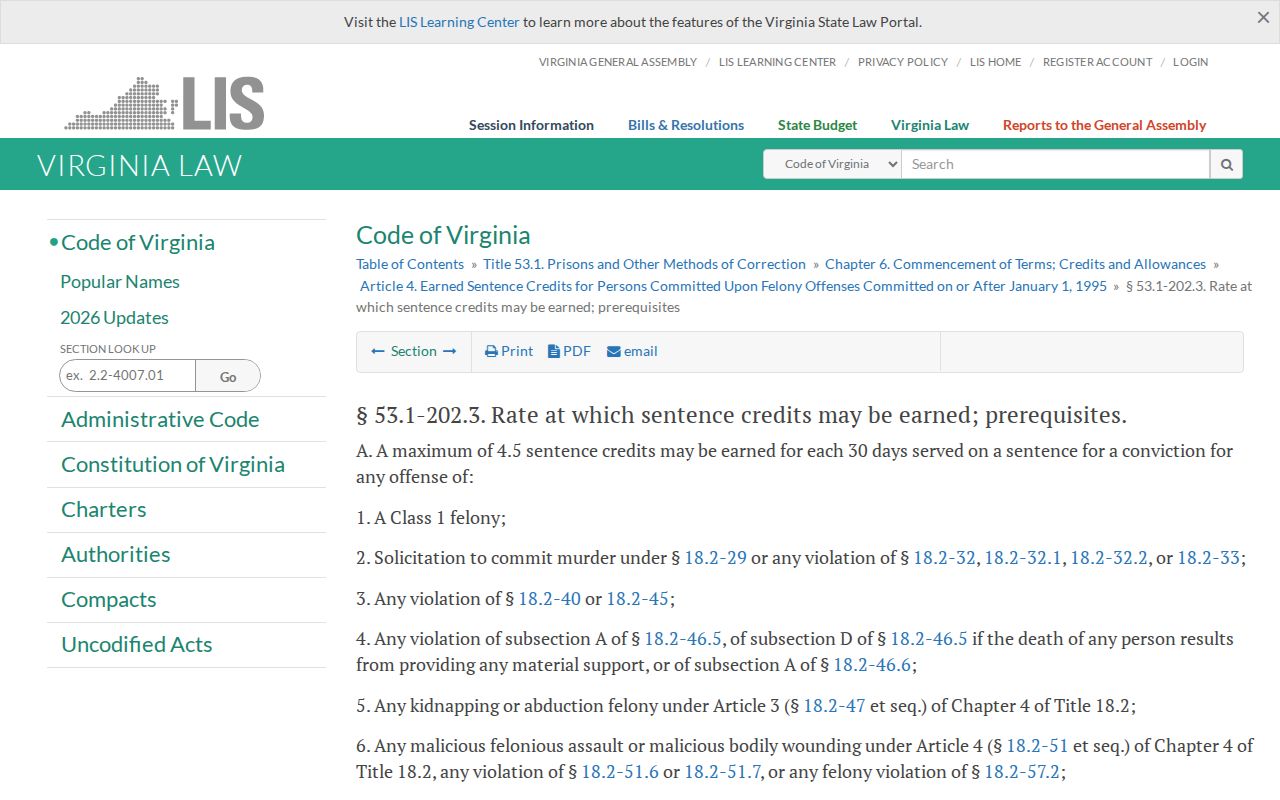
The statute shows why the offense category and assigned level must be known before credits can be tied to an Arlington County release date.
Arlington Jail Release Date Computation
A short local sentence may be computed by the local authority. A state-responsible sentence can be computed by VADOC even while the person remains physically at a local or regional jail. That is why ACDF's address alone does not identify who owns the calculation. Ask ACSO which agency maintains the computation for the sentence in question.
Useful inputs include the imposed sentence, active time, jail credit earned before VADOC intake, the governing credit system and class, disciplinary events, and whether sentences run at the same time or one after another. Later court orders also matter. VADOC directs individual calculation concerns to its Court & Legal or Correspondence Unit, P.O. Box 26963, 6900 Atmore Drive, Richmond, VA 23261, with the main line at 804-674-3000.
- Active time
- The part of the imposed term that must be served, before lawful credits and later changes are applied.
- Jail credit
- Time already spent in qualifying custody that the responsible authority applies to the sentence.
- Consecutive sentences
- Terms served one after another rather than at the same time.
- Earned sentence credit
- A statutory deduction based on eligibility, rate, conduct, and administration.
Online arithmetic cannot account for every official input. A rough calendar count should never replace the agency's computation record.
Why Arlington Release Dates Change
A shift in date does not automatically mean an error. The agency may have received new jail-credit data, applied a court order, changed a credit class, or recorded a disciplinary forfeiture. Another custodian may also have a valid hold. Read the reason and the source before comparing an older forecast with a newer one.
| Factor | Possible effect | Record to check |
|---|---|---|
| Jail-credit correction | Moves the computation when verified prior custody is added or revised. | Sentencing order and agency computation. |
| Credit class or conduct | Changes the rate earned or causes forfeiture under governing rules. | VADOC computation and disciplinary record available through proper channels. |
| Court modification | Changes active, suspended, concurrent, or consecutive time. | Latest certified court order. |
| Detainer or warrant | May send the person to another custodian instead of the community. | Holding and receiving agency records. |
| Parole decision | A grant can begin planning but does not prove that physical release occurred. | Parole Board decision and VADOC release documents. |
| Processing or data lag | Creates a short conflict between court, notification, and locator displays. | Event timestamps and confirmation from the record owner. |
Virginia generally bars ordinary discretionary parole for felony offenses committed on or after January 1, 1995 under § 53.1-165.1, but statutory exceptions exist. Parole eligibility must be checked against the actual sentence and current law. It cannot be assumed from age, term length, or an old estimate.
Confirm Arlington County Actual Release
A scheduled date answers when departure is currently expected. Final confirmation asks what happened. For ACDF, request the booking and release record from ACSO, led by Sheriff Jose Quiroz Jr. on the research date. Ask for the date, time, disposition or type, releasing authority, and receiving agency if it was a transfer. Pair it with the General District Court or Circuit Court order. For VADOC, use the signed notification-of-release letter, Order of Release or conditions, actual-release notice, and agency record.
Virginia Jail VINE can alert an eligible user to a local custody change, while NAAVI handles eligible VADOC notices. The systems are separate. The Arlington County VINELink release check explains how to select the correct person and distinguish a transfer from community release.
When records disagree, compare their timestamps and scope. A court order may precede jail processing. A local transfer alert may appear before the destination locator is populated. Keep the conflict open until ACSO, the court clerk, or VADOC confirms the part of the event it owns.
Note: A date tied to release from one custodian says nothing final about another agency unless the destination record is also reconciled.