
Understanding Arlington County Releases
A person is released from Arlington County custody when the legal basis for that custody ends or another authorized custodian takes control. Those outcomes are not the same. Someone may leave the Arlington County Detention Facility after posting bond, receiving personal recognizance, completing a sentence, obtaining a court-ordered discharge, or satisfying another release condition. Another person may leave the same jail in a secure transfer to the Virginia Department of Corrections, another jail, a federal custodian, or immigration custody. The Sheriff's public query does not retain a historical entry that explains which event took place.
The agency that controls the next stage controls the next useful record. ACSO owns the local booking and release transaction. Arlington General District or Circuit Court records the order or case event that authorized release. VADOC holds state custody and supervision records. Federal Bureau of Prisons and ICE systems have narrower federal scopes. This is why a name disappearing from one roster cannot establish community release on its own.
- Discharge
- The end of a particular custody or supervision term.
- Time served
- A sentence satisfied by time already spent in custody.
- Transfer
- A move to another authorized custodian, not a community release.
- Detainer
- A request or legal basis affecting what happens when current custody ends.
Arlington County Release Paths
Release language should be read in context. A bond order permits release after its terms are met, while personal recognizance generally does not require a secured payment. Pretrial supervision can place a person in the community under court-set conditions. Sentence completion and time served end the active local jail term, though probation or another obligation may follow. A dismissal can remove one basis for custody, but another charge, warrant, or hold may still prevent departure.
| Custody event | What it means | Best next record |
|---|---|---|
| Recognizance or bond | The court or magistrate authorizes release when stated terms are met. | Court order plus ACSO release transaction |
| Time served or sentence end | The active local jail term is complete. | Sentencing record plus ACSO release time |
| Pretrial or probation term | The person is outside the jail but remains subject to court conditions. | Court order and the assigned supervision office |
| State or federal transfer | Local custody ends while custody continues elsewhere. | ACSO destination field plus the receiving system |
| Immigration transfer | A qualifying judicial warrant supports continued detention and transfer. | ACSO record, warrant context, and ICE confirmation |
A release record should distinguish these events if the relevant fields exist. Arlington has not published a local code dictionary, so no shorthand release code should be guessed or expanded without the Sheriff's own definition.
What Arlington Release Records Show
The most useful request ties a release back to one custody episode. Names alone can collide. A booking number, subject number, court docket, date of birth, and approximate date range help ACSO locate the right existing record. The current inmate detail may expose several of those identifiers before it disappears. Save them when lawful and relevant. A court docket gives the legal result, but ACSO's transaction is the better source for the time the jail processed departure.
| Requested field | What it can establish |
|---|---|
| Booking or subject number | Connects the release to the correct local custody episode. |
| Admission and release date or time | Marks the period ACSO recorded the person in its custody. |
| Release disposition or type | Records the event used to close that local custody episode. |
| Releasing authority or order | Identifies the court or other authority behind the event. |
| Destination or receiving agency | Separates community departure from a custodial transfer. |
| Commitment and release documents | Provides the source paperwork tied to custody and departure. |
| Adult booking photograph | Connects the requested image to the initial intake record. |
Not every field is necessarily kept in the same form or open to every requester. Ask for existing records and existing fields. Do not ask the Sheriff's Office to create a new narrative, infer a destination, or certify facts that its record does not contain.
Request Arlington County Release Records
The ACSO FOIA contact is the direct channel for an adult local booking or release record. On the research date, Sheriff Jose Quiroz Jr. led ACSO, and the listed FOIA contact was Captain Robert Morrill, 1425 North Courthouse Road, Suite 9100, Arlington, VA 22201, phone 703-228-4468, and email acsofoia@arlingtonva.us. Staff assignments can change, so the published office page should control. Virginia permits mail, email, telephone, or in-person requests. A written request makes the identifiers, date range, desired format, and cost limit much clearer.
- Identify the adult by name and date of birth, then add a booking, subject, or docket number when known.
- Give the approximate admission and release dates. Ask for the booking and release record, release date and time, recorded disposition, authority, and destination if maintained.
- Request electronic delivery in an existing format. Ask for an estimate before costs are incurred and for the legal basis of any withholding or redaction.
- Compare the ACSO response with the latest court order. If the record names a receiving custodian, check that custodian separately.
ACSO's stated standard labor rate became $30 per hour on July 1, 2026. Its page says an estimate of $200 or more triggers an estimate and a 50 percent deposit under the posted policy. Under Virginia Code § 2.2-3704, the usual response period is five working days, with a seven-working-day extension available in the stated circumstances. Time may pause around an estimate or deposit. Narrow requests reduce both search time and confusion.
Virginia Law on Arlington Releases
Virginia FOIA supplies the access process, fee limits, response options, and timing. It does not set the retention period for every Sheriff's record. No official online retention window for Arlington booking and release records was found. Ask ACSO whether the record remains under the applicable Library of Virginia schedule. A public detail vanishing from the roster is an online display rule, not proof that the underlying record was destroyed.
Virginia Code § 2.2-3706 provides a request route for specified adult routine-intake photographs and basic arrest or status information, subject to its exceptions. Other correctional, investigative, medical, juvenile, sealed, or expunged material may be withheld, redacted, or barred from disclosure. A legally sealed record can produce a response that no record exists for an unauthorized requester. That response should not be turned into a claim that no custody event ever occurred.
Note: Juvenile records follow separate confidentiality rules and must not be requested or displayed as adult jail records.
Arlington County Bond Release
Arlington's booking material describes a local sequence that begins with a magistrate. Depending on the ruling, the arrested person may receive personal recognizance, arrange a secured bond, enter supervised pretrial release, or remain committed while bond is unavailable or unmet. The Arlington Magistrate's Office operates at all times, but it does not conduct warrant business by telephone. A bond decision authorizes a path out of custody; it does not prove the time ACSO finished processing release.
Conditions matter. Funds, identity checks, another hold, or paperwork may separate the court event from physical departure. The court order answers what was authorized. The release transaction answers when local custody ended. If a current roster record disappears during that interval, confirm both records rather than treating the missing result as a timestamp.
Arlington County Release Counts
ACSO reported 3,662 admissions and 3,631 releases in its 2021 annual report. That same dated report counted about 49 federal-system detainees and an average daily population near 260. A separate 2024 annual-report announcement listed an average daily population of 364 and an 87 percent success rate for people placed on pretrial supervision. The years must stay attached. These figures describe past operations and should never be presented as a live release counter.
The figures also show why custody type matters in Arlington. Some people at ACDF are connected to federal proceedings. A local departure may therefore lead to federal transport rather than the community. Operational totals cannot resolve an individual record.
Transportation After Arlington Release
ACDF and the courthouse complex sit near the Court House Metrorail station on the Orange Line, with Metrobus and Arlington Transit service nearby. Official facility material also notes bicycle, walking, and car-share access. These are nearby public travel options. They are not a ride supplied by the Sheriff, a confirmed discharge exit, or an approved waiting place for family or friends.
No official source identified the exact release door, pickup rules, or a standard discharge hour. Call ACSO at 703-228-4460 for day-specific logistics before traveling. A court date or expected release does not guarantee that processing is complete. Other holds can also change the outcome.
Find Arlington County Released Inmates
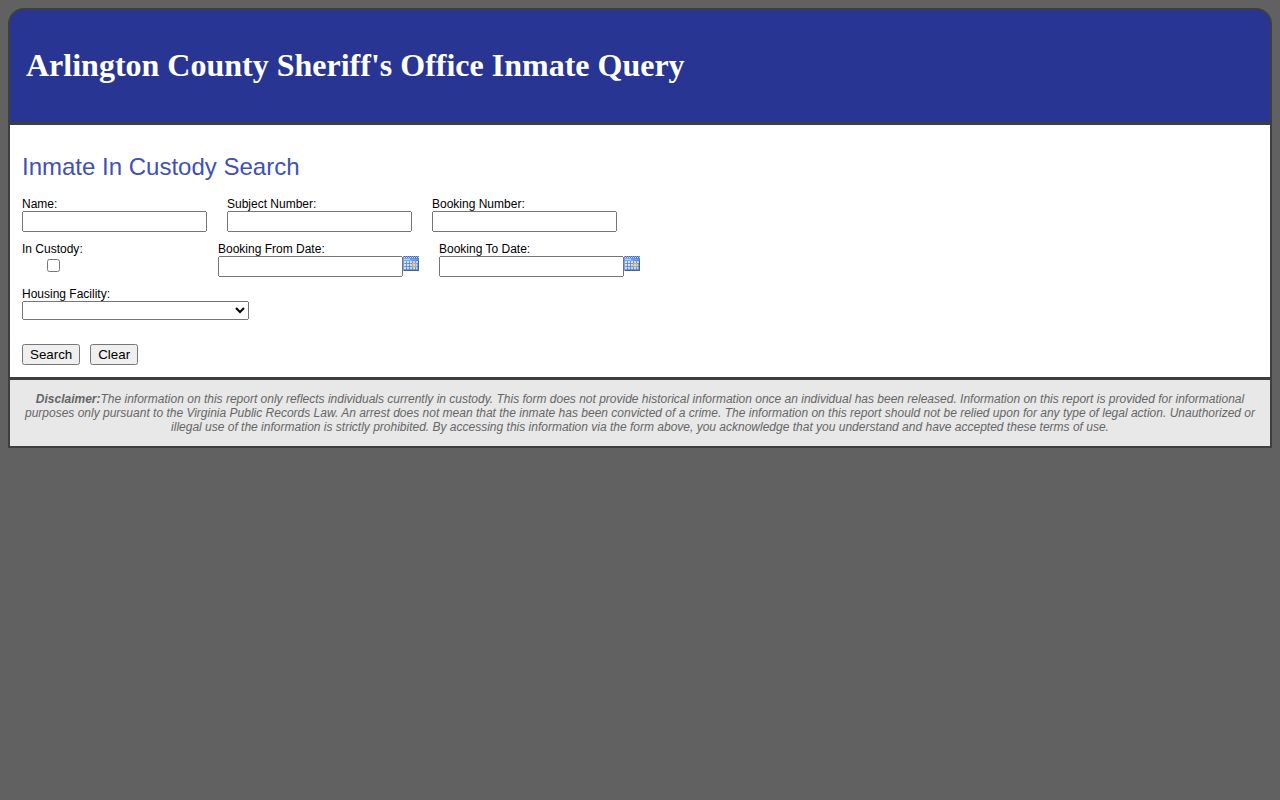
Start with the ACSO Inmate In Custody Search only to test present local custody. Its disclaimer controls: the results show people currently in custody and provide no historical information after release. Booking From Date and Booking To Date do not turn it into a release archive. The manifest capture below shows the official current-only query that anchors this distinction.
- Search the ACSO query by name, subject number, or booking number. Save the booking and docket identifiers if a lawful current result appears.
- Check the proper Arlington court for the latest bond, disposition, sentence, probation, or later order.
- Request the ACSO release record for the departure time, event, authority, and destination if recorded.
- Use Virginia Jail VINE for a local custody event and NAAVI only for eligible state-custody notifications.
- Search VADOC, BOP, or ICE only when the facts point to that custodian. Each tool has a different scope.
Arlington Court Release Proof
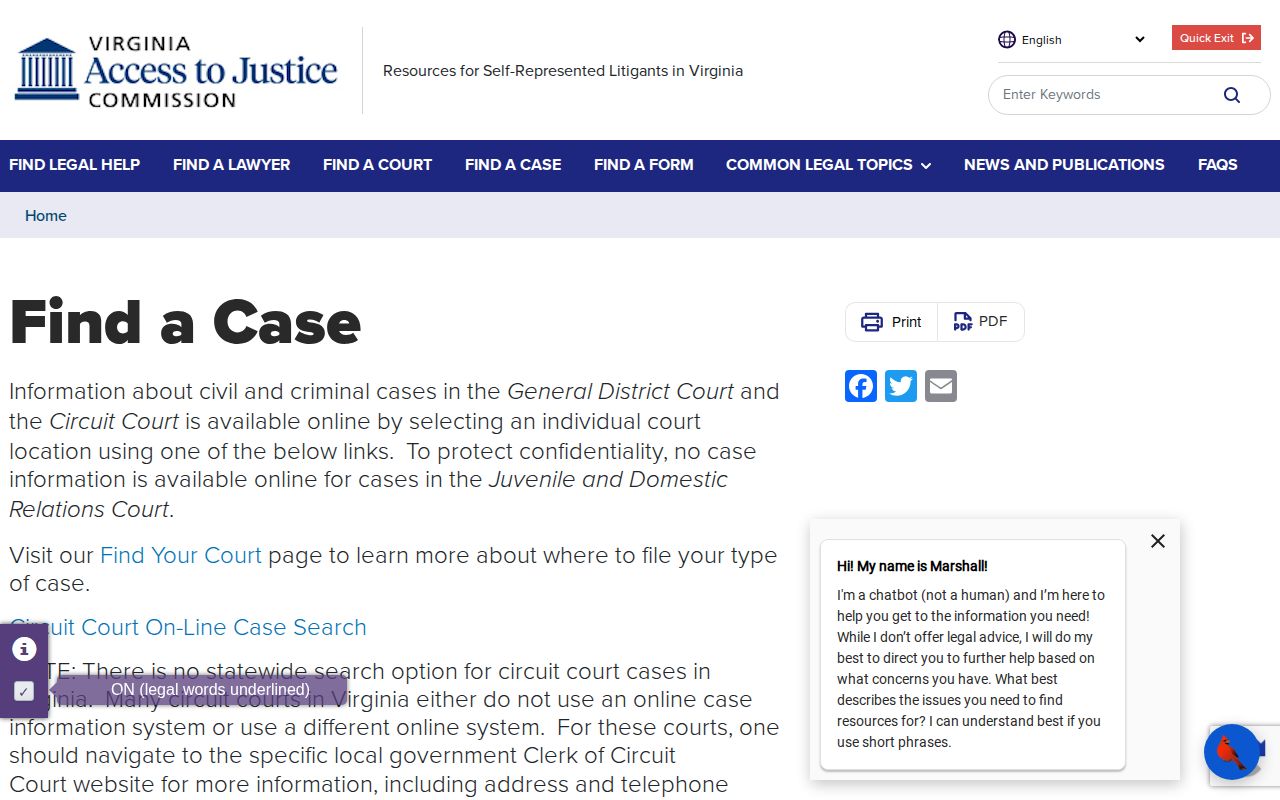
Arlington release confirmation can cross three court tiers. General District Court handles misdemeanors and preliminary felony matters. Circuit Court handles felony trials and appeals from General District Court. Juvenile and Domestic Relations District Court protects its case information and offers no public online case lookup. The Virginia Judiciary Find a Case route helps locate the correct adult public system, but the clerk remains the source for a complete or certified order.
A saved docket number creates the cleanest bridge from a current ACSO detail to the later court record. Read the latest order and disposition, not just the first charge. A dismissal may leave another hold. A time-served sentence does not state the processing minute. Circuit criminal copy requests can be sent to CCT-DocRequest@arlingtonva.us; the published charge is $0.50 per page plus $2 for certification, and the office says it aims for two business days, subject to volume. Pair that judicial record with ACSO's release transaction.
The captured Virginia Judiciary court-search route shows the statewide starting point used to identify the proper Arlington record.
VADOC Search for Arlington Releases
The VADOC Inmate and Supervisee Locator covers people currently under specified forms of state custody or supervision. Its scope includes state institutions, probationers and parolees supervised by district offices, institutional hospitals, some state-responsible people in local or regional jails, and CCAP participants. It updates daily and warns that data may be inaccurate or out of date. It is not promised as a permanent archive of fully discharged people.
| Search field | Use | Research note |
|---|---|---|
| First and last name | Primary name route | The first three letters of the first name may be used with the full last name. |
| Seven-digit DOC ID | Identifier route | An Arlington booking number is not automatically a VADOC ID. |
| Location | Optional filter | Use only when the likely state location is known. |
| Race, gender, age range | Optional identity filters | Compare identity carefully and accept the portal disclaimer. |
The research did not verify an exact public label for a projected or expected release field on a real result. Do not invent one. A current supervision match can show that someone is outside prison while still under state authority, but it may not distinguish parole from probation without the court order. For a full discharge, use VADOC records and release documents.
The VADOC facility release process describes a notification-of-release letter and signed release or supervision documents. Those records are stronger evidence than a name simply vanishing from a locator.
Arlington County Release Notifications
Virginia uses two notification systems. Virginia Jail VINE serves local and regional jail custody events. Search the person, confirm that Arlington or ACDF is the reporting agency, and read the exact event. A local release or transfer notice ends that reporting jail's custody but may point to another custodian. Registration before release can preserve the custody change; telephone help is 1-800-467-4943.
VADOC uses NAAVI for eligible state-custody notifications. Its events can include advanced release, an actual release date, completed transfer, work release, parole events, and other changes. Local Jail VINE registration does not automatically transfer to NAAVI. The two systems must be checked according to custody type.
Federal and immigration tools are narrower. The BOP locator can show Released or Not in BOP Custody and a release date for federal records from 1982 forward, but that status ends BOP custody only. ICE's Online Detainee Locator reports current detention and has no historical release archive. The USMS has no comparable public released-person locator. Federal dockets and custodian records supply the durable proof.
Arlington Reentry After Release
Arlington has a Sheriff Reentry Committee and a Community Readiness Unit. The Reentry Committee describes assessment at intake, pre-release meetings, referrals, discharge-plan review, and follow-up. The Community Readiness Unit describes risk assessment, individual planning, workshops, therapy, post-release case management, support groups, and family support. These are transition resources, not custody searches and not proof of release.
State supervision is separate. VADOC District 10 serves Arlington County and Falls Church from 3300 North Fairfax Drive, Suite 320, Arlington, VA 22201, phone 703-875-0100. A locator match, court order, and office routing can help distinguish parole, probation, or another post-custody term. Arlington parole and probation verification also depends on the exact court order, and absence from a selective wanted list proves nothing.
Arlington ICE Release Checks
Arlington's published policy adds a precise local rule. ACSO does not keep someone solely on an ICE administrative detainer after local charges are satisfied. Continued detention requires an accompanying judicially issued warrant. When that requirement is met, ACSO notifies ICE to facilitate transfer. A person may therefore disappear from the Arlington roster without entering the community.
The next check depends on evidence. Ask ACSO whether its existing release record identifies ICE or another receiving agency. Review the warrant and court context when accessible. Then use the ICE locator for current detention, searching by A-number and country of birth or by biographical details. A negative ICE result is not historical proof of release because transfer, processing delay, spelling, protected information, removal, or another custodian can explain it.
ACDF Visits After Arlington Release
ACDF's January 2025 rules contain an unusual local post-release limit. A person released from ACDF within the prior 30 days is not eligible for on-site or video visitation. That rule may affect plans to visit someone who remains at the facility, but it does not establish the former detainee's exact release date.
Use the ACSO release record for the actual date and time. The rule also shows why facility policies and custody records serve different purposes. A visitation decision may rely on a recent release, while the booking and release transaction remains the source for confirming when the local custody episode ended.
Compare Arlington Release Sources
No single source covers every Arlington County released inmate. Match the source to the custodian and the question being asked. Present custody, departure from ACDF, court authority, state supervision, and federal release are separate facts.
| Source | Best use | What a miss means |
|---|---|---|
| ACSO current query | Confirm current adult local custody and preserve identifiers. | Expected after release; no reason, time, or destination is proved. |
| ACSO release record | Confirm the local departure event, time, type, and recorded destination. | Ask about identifiers, retention, or the correct custodian. |
| Arlington courts | Confirm bond, disposition, sentence, probation, or later orders. | Check the right court and confidentiality limits. |
| VADOC locator and records | Check current state custody or supervision and obtain state release documents. | No permanent fully discharged-person history is promised. |
| BOP or ICE | Check the relevant federal custodian within that tool's scope. | Another custodian or a processing issue may still exist. |
Arlington County Release Facilities
Arlington County Detention Facility is the county's adult local jail. ACSO operates it, and its public query covers current custody only. Community release, state or federal transfer, another jail, a medical move, and a qualifying immigration transfer require different follow-up records. The Sheriff's booking and release transaction is the starting point for proving departure from ACDF.
Northern Virginia Juvenile Detention Center is a secure regional juvenile facility in Alexandria that serves Arlington, Alexandria, and Falls Church. Its placements and releases are court-driven, and its records are not part of the adult ACSO query. Authorized parties must use Juvenile and Domestic Relations District Court, facility, or Virginia Department of Juvenile Justice channels. The center's former federal agreements ended in 2018 and 2019 and are not current release routes.
Facility scope prevents false conclusions. Release from one building can lead to the community, supervision, or another custodial system. Confirm both the departure and the destination before describing the outcome.